
Materiality
We have updated our materiality to reflect changes in the social and business environment, as well as the revision of our Mission, Vision and Value. Rooted in Mitsubishi Corporation’s Three Corporate Principles, our Management Philosophy guides our fair and sound business activities as a wholly owned subsidiary of Mitsubishi Corporation.
For us, materiality defines the key issues we should prioritize over the medium to long term, both in creating value through our business and in strengthening the management foundation that supports that value creation. It serves as an important guide for translating our Management Philosophy into specific management issues and linking them to our management plans, business plans, and various initiatives.
Overview of Materiality
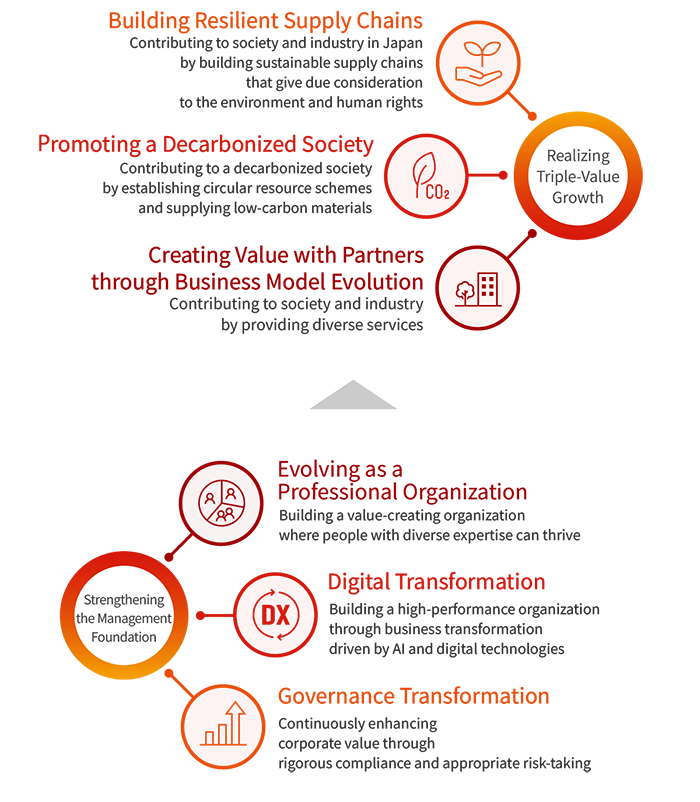
Materiality Review Process
The review of our materiality followed a bottom-up process, drawing on frontline discussions across divisions and departments and taking into account future changes in the social and business environment.
Divisions and departments discussed the future state they aspire to achieve, the society they seek to help realize, and the medium- to long-term challenges required to achieve these goals. The outcomes of these discussions were then consolidated by business unit, reviewed from a stakeholder perspective, discussed company-wide, and ultimately approved by the Management Committee as the Company’s materiality.
Materiality Review Process
Step 1
Identification of Potential Issues

Future changes in the social and business environment, as well as societal issues, were examined to identify issues relevant to our businesses and functions. We also reviewed internal factors, including our strengths and weaknesses, to clarify the basis for the materiality review.
Step 2
Assessment of Impacts, Risks,
and Opportunities

The identified issues were assessed in terms of their potential impacts, risks, and opportunities for the Company. We also considered the interrelationships among these issues to develop a structured understanding of the issues that will be important over the medium to long term.
Step 3
Defining the Desired Future State and Medium- to Long-Term Challenges

Each division and department discussed the future state it aspires to achieve and the society it seeks to help realize in light of the Company’s Management Philosophy. Based on these discussions, medium- to long-term challenges that the Company should address to achieve them were identified.
Step 4
Integration and Structuring by Business Unit

Based on the results of discussions in each division and department, workshops were held at the business-unit level. Through these workshops, each business unit clarified its direction, reviewed the priority and importance of the issues, and organized and articulated the medium- to long-term challenges.
Step 5
Stakeholder Perspective Review and Company-wide Finalization

The medium- to long-term challenges organized by business unit were reviewed and validated from stakeholder perspectives. Following discussions at the Medium- to Long-Term Strategy Meeting and the Management Committee, they were finalized as the Company’s materiality.
Integration into Management and Continuous Review
Our materiality will be reflected in our management plans and sustainability initiatives and will serve as an integral part of our business activities. Going forward, we will apply the PDCA cycle to continuously monitor the progress of our initiatives and regularly review and update them in light of changes in society, the business environment, and stakeholder expectations.